Your Forklift Match Starts Here
Buying a forklift isn't about scrolling listings and guessing specs, it's about matching the lift solution to your work reality: Indoors or out? Smooth concrete or rough terrain? Tight aisles or open yard? Daily production lift or backup coverage? Those answers determine what type of forklift you need, what power system makes sense, and what configuration will actually hold up on your site.
This buying guide exists to help you think through the variables that matter before you ever commit to a lift. If you already know what you need, you can skip the theory and go straight to a quote. If you're still narrowing it down, this guide will get you oriented fast so you don't waste time on forklifts that are never going to fit your operation.
What This Buying Guide Will Cover
This guide is organized around the same framework our Matchmakers use every day. Instead of model lists and sales talk, it walks through the real factors that determine whether a forklift will succeed or fail in your specific environment.
Inside this guide, you'll learn how to evaluate:
- Forklift types and the jobs they're built for
- The 4 inputs that determine the right forklift
- Surfaces, tires, and traction
- Power systems and operating costs
- Capacity, lift height, aisle width, and mast configurations
- Attachments and customization
- Condition lanes and how new vs. used actually works
Each section ties back to one goal: helping you identify the equipment lane that fits your work, so when you request a quote, you're matching the need to a solution, not guessing.
Why Every Forklift Gets a Name (and Why That Matters)
Here at Discount Forklift, we consider ourselves the Equipment Matchmakers. We actually name each piece of our equipment. No different than how people name their favorite car, boat, or the iconic cars from Gone in 60 Seconds. Take Rae, a 2001 Hyster electric pallet jack with a 4,000 lb capacity that runs on 24V power. She's not a random listing. She's a specific lift with real specs, real photos, and a defined work lane. Or take Suzette, a 2008 Hyster pneumatic sit-down built for serious weight, 36,000 lbs, diesel power, and equipped with a side shift and fork positioner. Two completely different lifts, two completely different jobs, and both are tracked like individuals because that's how you avoid buying a mystery lift off a dock.
Along with her personalized name, each forklift has been carefully sourced, documented, serviced, and repaired, then run through our paint and body shop so she looks as good as she runs. After that she is photographed, and the Virtual Test Drive is filmed. You can also explore more of these Virtual Test Drive videos on our YouTube channel. Each unit is then connected to real details that match real work.
When you call, you don't get bounced around trying to explain the yellow one with the forks. You ask about Rae or Suzette, and we pull up the exact unit, the exact configuration, and what it was built to do. That's how we keep the process fast, personable, clean, and fun, because forklifts aren't commodities, and neither is your operation.
How to Choose the Right Forklift Supplier
Choosing the right forklift is only part of the decision. The supplier you work with determines how accurate the match is, how efficient the process feels, and how well the equipment performs once it arrives. In a market filled with listings, mixed-condition lifts, and unclear specs, the right supplier removes guesswork and keeps your focus on what actually matters: getting the right lift for the job.
Equipment Matchmakers
- Start with how your operation actually runs day to day.
- Identify key requirements before recommending equipment.
- Narrow options into forklifts that fit your workload and environment.
Nationwide Equipment Access
- Source forklifts from a broad network across the United States.
- Provide flexibility in specs, availability, pricing and financing.
- Avoid being limited to what is sitting in one location.
Evaluated, Work-Ready Equipment
- Review overall condition before recommending any machine.
- Prioritize reliability and real jobsite readiness.
- Match equipment that is prepared for real-world use.
Coordinated Delivery
- Arrange shipping directly to your facility or jobsite.
- Manage logistics from approval through arrival.
- Ensure equipment arrives ready to work.
Look No Further: You've Already Found the Supplier You Need
The same factors that define a strong forklift supplier; accurate matching, broad equipment access, real-world-ready machines, and coordinated delivery, are built into how Discount Forklift operates each and every day. Instead of sorting through listings or guessing your way to a decision, you work directly with Equipment Matchmakers who narrow the field and connect you to forklifts that actually fit your operation.
Forklift Types and the Jobs They're Built For
Choosing forklift type is your first filter. It determines what the machine can physically do, what surfaces it can handle, and how tight your operating space can be.
Forklift Types at a Glance
| Forklift Type | Best For | Key Strengths | Typical Environment |
|---|---|---|---|
| Sit-Down (Cushion/Pneumatic) | General lifting, docks, mixed use | Versatile, wide capacity range | Indoor / Outdoor (depends on tires) |
| Stand-Up Forklifts | Fast warehouse movement, frequent in/out | Quick entry/exit, tight turns | Indoor |
| Reach Trucks / Narrow-Aisle | High racking in tight aisles | Reach + height + storage density | Indoor |
| Order Pickers | Piece picking at height | Lifts operator + load | Indoor |
| Manual/Electric Pallet Jacks | Short moves, truck bays, staging | Simple, tight spaces | Indoor |
| Walkie Stackers / Straddle | Light stacking in small spaces | Vertical lift without big footprint | Indoor |
| Rough Terrain Forklifts | Outdoor yards, dirt, uneven ground | Clearance + traction + stability | Outdoor |
How to Choose Your Forklift Type in 60 Seconds
- If you're mostly indoors on concrete, start with sit-down cushion or stand-up.
- If you're tight aisles + high racking, you're in reach/narrow-aisle territory.
- If you're piece picking, you're looking at order pickers.
- If you're mostly outdoors on gravel/dirt, you're in pneumatic or rough terrain territory.
- If you're mostly moving pallets short distances, start with pallet jacks or walkies.
Before You Go Deeper: Types vs. Specs
Forklift types are a helpful starting point. They narrow the field.
The real match is built from specs, where you drive, how hard the machine will work, where you stack, and what you lift. Those factors determine tires, power systems, mast setups, and real lifting capacity.
If you want to understand why certain forklift types fit your job, continue into the spec sections below.
If you'd rather keep browsing forklift families and come back to the mechanics later, you can jump straight to types.
The 4 Inputs That Determine the Right Forklift
Every correct forklift decision starts the same way. Not with brands. Not with listings. Not with price. With your specific operational requirements. Before you look at models, power types, or pricing, you need four inputs. These are the same four factors our Matchmakers use to narrow thousands of lifts into real quotes. Everything else in this guide is just the spec language that comes after these inputs are clear.
Think of it like this: each input points directly to the next section of this guide. If you know where you drive, you can narrow down the tires and stability. If you know how hard the lift will work, you can narrow down the power and long-term operating costs. If you know where you stack, you can narrow down the mast and clearance. If you know what you lift, you can confirm the real capacity and whether attachments are required.
-
Where You Drive
Your surface and environment decide what forklift can safely do the job. Smooth indoor concrete, outdoor yards, mixed dock traffic, slopes, debris, and weather exposure all change the requirements for traction, clearance, stability, and even which power systems are practical. Get this part right, and the rest of the spec decisions get easier, because you're building on a forklift that can actually move and handle loads confidently in your real conditions.
-
How Hard It Will Work
Workload determines the smartest ownership plan. A forklift running a couple hours a day has a different best buy than a unit running full shifts under constant pressure. Hours per day, days per week, indoor vs. outdoor stress, and whether the lift is primary production or backup coverage all affect the right power system, expected operating cost, and which condition tier makes sense. Match the forklift to the duty cycle, and you reduce downtime risk and long-term cost surprises.
-
Where You Stack
Space is where most forklift mistakes show up. Lift height, aisle width, racking layout, door clearances, trailer work, and overhead obstructions all affect which mast and overall forklift size will physically fit. The problem usually isn't the forklift, it's buying without measurements. When you confirm the tightest aisle, the lowest clearance, and the true stacking height, the right mast setup and equipment class becomes obvious.
-
What You Lift
Capacity isn't just a number on the nameplate. Load shape, length, stability, and center of gravity can reduce usable lifting power fast, especially once you add attachments. Two loads can weigh the same and behave completely differently, which is why what you lift has to include the full load reality, not just the weight. When you define the load properly, you can size the forklift with the right safety margin and choose any attachments without guessing.
Where You Drive: Surfaces, Tires & Traction
Not all forklifts are built for the same ground. Choosing the right tire setup affects safety, stability, equipment life, and daily operating cost. Whether you're running on polished warehouse concrete, outdoor gravel, or mixed-surface loading docks, tire type matters just as much as lift capacity or power source.
Concrete, Asphalt, or Dirt: Choosing the Right Forklift for Your Surface
Your surface is one of the fastest ways to get you in the right forklift lane.
- Indoor warehouse environments typically call for cushion-tire forklifts. They're compact, smooth-riding, and built for tight turns on flat concrete.
- Outdoor or mixed-surface jobsites usually require pneumatic tires for traction and stability on asphalt, gravel, and uneven ground.
- Indoor-outdoor crossover operations often use electric pneumatic forklifts, which combine clean indoor operation with the ability to handle rougher surfaces.
Cushion Tires vs. Pneumatic Tires vs. Rough-Terrain Tires
- Cushion Tires: Pressed onto the wheel rim and best for indoor, flat surfaces. They allow for a smaller turning radius and are ideal for warehouse and dock environments.
- Pneumatic Tires: Filled with air or made from solid rubber. Designed for outdoor and mixed environments where uneven surfaces are common.
- Rough-Terrain Tires: Oversized, deeply treaded pneumatic tires built for the most demanding conditions: construction sites, lumber yards, farms, and debris-heavy yards.
Each option carries trade-offs in traction, maintenance, cost, and operating environment.
Tire Options by Application
| Tire Type | Best Use Case | Surface Type | Maintenance |
|---|---|---|---|
| Solid Pneumatic | Outdoor, debris-heavy yards | Asphalt, gravel | Low |
| Air Pneumatic | Smoother ride on rough ground | Dirt, uneven ground | Medium |
| Poly | Quiet, clean indoor operation | Indoor only | Low |
| Turf | Landscaping and delicate surface work | Grass, turf | Medium |
| Rough Terrain | Heavy-duty outdoor operations | Dirt, mud, gravel | Medium |
Still not sure? A short conversation with a Matchmaker usually turns tire and surface selection into a 60-second decision.
Power & Engine Types: How Your Forklift Runs (and What It Costs)
Your forklift's power system affects where it can operate, how much it costs to run, how often it needs service, and how long it will realistically last in your environment. Choosing power isn't just about preference. It's about matching energy sources to workload, location, and long-term operating cost.
Electric Forklifts: Voltage Systems & Lithium-Ion Options
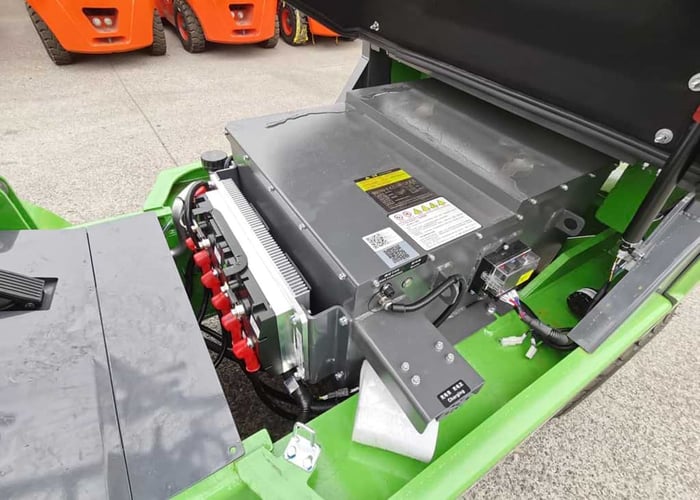
- Electric forklifts deliver zero emissions, quiet operation, and low daily maintenance. They are the dominant choice for indoor operations and are now powerful enough for many outdoor and mixed-surface applications.
- 24V systems are typically used in pallet jacks, walkies, and light-duty stackers where compact size and short runs matter most.
- 36V / 48V systems power the majority of warehouse sit-down and stand-up forklifts, offering a strong balance between runtime, lifting power, and operating cost.
- 80V / 96V systems support heavier electric forklifts designed for higher capacities, longer shifts, and demanding warehouse or outdoor-yard work.
- Lithium-ion batteries offer fast charging, consistent power output, no watering, and long service life. They are ideal for multi-shift operations, opportunity charging, and facilities focused on uptime and reduced maintenance labor.
Electric forklifts often deliver the lowest lifetime operating cost through reduced fuel expense, fewer service items, and longer component life. When evaluating electric forklift cost, factor in charging infrastructure, battery replacement cycles, and the energy savings that compound over thousands of operating hours.
LP (Liquefied Petroleum) / Propane Forklifts
- LP forklifts balance combustion power with cleaner indoor usability. They refuel in minutes, provide consistent torque, and perform well in mixed indoor-outdoor operations.
- Suitable for both indoor and outdoor work environments.
- Minimal downtime due to fast tank swaps.
- Strong performance on ramps, docks, and incline work.
- Easy fuel storage and distribution for high-frequency fleets.
LP remains one of the most flexible power choices for facilities that cross between warehouse floors and outdoor yards.
Diesel Forklifts for Heavy Outdoor Work
- Diesel forklifts are built for sustained outdoor lifting where power and durability matter more than emissions.
- High torque output and strong continuous runtime.
- Best suited for loads above 6,000 lbs and heavy attachments.
- Designed for construction sites, ports, yards, mills, and long outdoor shifts.
- Not suitable for indoor use due to fuel-related emissions.
Diesel typically carries higher fuel and service costs, but delivers considerable outdoor power. Understanding diesel forklift cost means looking beyond sticker price and accounting for fuel consumption, filter changes, and the heavier maintenance schedule that comes with combustion systems.
Dual-Fuel and Gasoline Forklifts
- Dual-fuel forklifts allow operation on LP or gasoline, providing flexibility when fuel supply or jobsite conditions vary.
- Gasoline forklifts are less common today but still appear in legacy fleets and rural operations.
- Useful where LP infrastructure is inconsistent or redundancy is required.
- Generally, less fuel-efficient than LP or electric alternatives.
These systems are most often chosen for operational flexibility rather than efficiency.
Power Type vs. Operating Cost Snapshot
| Power Type | Fuel Cost | Maintenance | Emissions | Ideal For |
|---|---|---|---|---|
| Electric | Low | Low | Zero | Warehouses, food, clean environments |
| LP / Propane | Medium | Medium | Low | Indoor/outdoor mixed use |
| Diesel | High | High | High | Heavy-duty outdoor lifting |
| Dual-Fuel / Gas | Medium | High | Medium | Rural sites, hybrid fleets |
Choosing a power system is not a short-term purchase decision. It's a multi-year operating plan that affects fuel spend, maintenance load, facility rules, and uptime.
Capacity, Height & Mast Types: Spec'ing the Heavy Lifting
Not every forklift is built to lift the same loads, or fit the same spaces. Whether you're stacking pallets in a warehouse or unloading pipe outdoors, lift specs determine safety, efficiency, and long-term uptime. Undershooting capacity or misjudging clearance leads to stalled workflows, equipment damage, and unnecessary risk.
How Much Weight Do You Need to Lift?
- Forklifts are rated for specific loads, and those ratings change with lift height, attachments, and load position.
- A forklift's nameplate capacity only applies under ideal conditions. Real-world work almost always reduces usable lifting power.
- Our inventory spans every major class, from light warehouse units to high-capacity outdoor lifts.
| Weight Class | Common Uses |
|---|---|
| 0 - 4,999 lb | Light warehouse loads, small pallet handling |
| 5,000 - 7,999 lb | Standard indoor/outdoor work, dock operations |
| 8,000+ lb | Heavy manufacturing, yards, oversized loads |
Tip: A forklift rated at 5,000 lb lifting 5,000 lb at full height is operating at its absolute limit. Always build margin into your capacity planning.
Lift Height, Aisle Width & Overall Lowered Height
- Lift height determines how high pallets can be stacked, staged, or racked. Typical ranges run from under 80" to over 200".
- Aisle width defines what types of forklifts can physically operate in your space. Reach trucks, stand-ups, and three-wheel electrics can work in aisles as narrow as 8 - 10 feet.
- Overall lowered height matters when forklifts must clear doors, trailers, containers, racking beams, or mezzanines.
Space constraints are just as critical as lifting power. A forklift that cannot turn, clear, or lower into your work zone becomes a liability immediately. We spec forklifts to real site measurements before shipment, not after arrival.
Mast Types Explained
Your mast determines lift height, collapsed height, visibility, and stability.
| Mast Type | Description | Best For |
|---|---|---|
| Two-Stage (V) | Basic lift with strong structure | Outdoor yards, ground-level stacking |
| Three-Stage (FV) | Compact lowered height with higher reach | Warehouses with racking |
| Quad Mast | Four rail sections for extended height | High stacking, tall warehouse applications |
| Ground Height | Minimal lift height | Containers, trailers, low-clearance work |
| Telescopic | Smooth multi-section extension | Specialized vertical access |
| Truckers Mast | Ultra-low collapsed profile | Loading inside box trucks or trailers |
Safety Margin: Why a 5,000 lb Forklift Shouldn't Lift 4,900 lb All Day
Forklifts are rated under controlled factory conditions. Real jobsites are not controlled.
- Attachments such as side shifters, clamps, and rotators reduce usable capacity.
- Lifting at full height lowers stability.
- Off-center loads, irregular shapes, tire wear, and surface conditions all affect performance.
Rule of thumb: Choose a forklift rated at least 20% above your typical lift weight. If you routinely lift 4,000 lb, a 5,000+ lb forklift is appropriate. A forklift that constantly runs at its limit is being overworked.
Now that you understand the non-negotiables; surface, power, space, and real lifting margin, the next move is choosing the forklift family that fits those constraints. Forklift types are not marketing categories. They're engineered lanes built around how and where the machine has to work. Below, we break down the major forklift types and the most common sub-types we stock, so you can get to the right lane faster.
Forklift Types: Match the Lift to the Job
With one of the nation's largest forklift inventories, we carry every major forklift type, each matched to the worksite, surface, and load it's built to handle. From warehouse aisles to construction yards, choosing the right machine is the first step to safety, performance, and uptime.
We break it down into 7 core forklift types for sale to help you get there faster:
- Sit-Down Forklifts for Sale
- Electric and Manual Pallet Jacks for Sale
- Walkie Stackers for Sale
- Reach Trucks & Narrow-Aisle Forklifts for Sale
- Order Pickers for Sale
- Rough Terrain Forklifts for Sale
- Stand-Up Forklifts for Sale
Need tight turns in narrow aisles? A reach truck or stand-up docker forklift is your go-to. Working outside on rough ground? A rough terrain unit has the clearance and stability you need. Not sure what fits your job best? Our Matchmakers will narrow it down in minutes, saving you time.
As you browse lifts on our easy-to-use Discount Forklift website, you'll see Virtual Test Drive videos available throughout the page. Each unit is filmed and hosted on our YouTube channel so you can see how it runs before you commit.
Sit-Down Forklifts
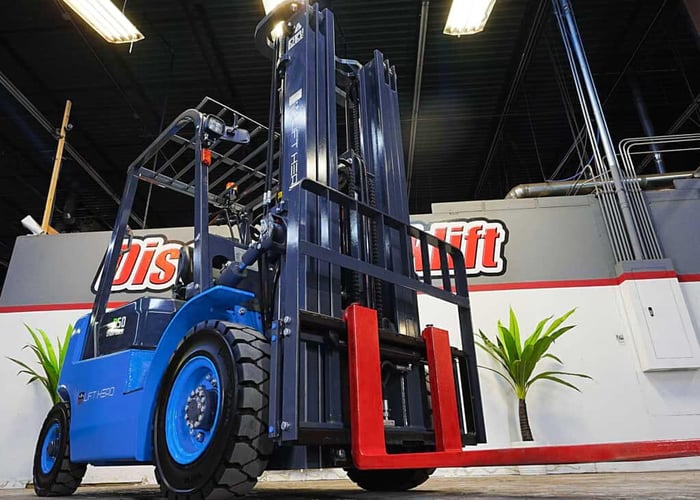
Sit-down forklifts are the most common general-purpose lifts. They're built for palletized loads, longer shifts, and operations where there's room to maneuver. Depending on tire type and power system, they can work indoors, outdoors, or across mixed environments.
They're often the right starting point for warehouses, docks, yards, and facilities running a wide variety of daily tasks. Sit-down forklift cost varies significantly depending on whether you're running cushion or pneumatic tires, electric or LP power, and new or used condition. But sit-down alone doesn't define whether a forklift will actually work on your site. Tire type, power, mast configuration, and duty cycle determine whether a sit-down becomes a long-term asset, or a daily frustration.
Sit-Down Forklift Overview
| Category | Summary |
|---|---|
| Best suited for | Palletized loads, dock-to-floor movement, and general warehouse or yard operations. Built for longer travel distances, sustained shifts, and mixed daily tasks like receiving, staging, racking, and loading. |
| Usually not ideal when | Aisles are extremely narrow, vertical storage density is the main constraint, operators constantly mount and dismount, terrain is undeveloped or highly uneven, or piece-picking replaces pallet handling. |
| What determines performance | Tire type (surface, traction, turning radius), power system (runtime, ventilation rules, operating cost), mast setup (lift height, collapsed height, clearance), true working capacity after attachments, and daily duty cycle. |
| Common buying mistakes | Choosing indoor tires for outdoor work, sizing to rated instead of real capacity, forgetting attachments reduce lift limits, buying tall masts that don't clear doors or trailers, and solving today's job but not next year's workload. |
Most sit-down forklift problems aren't forklift problems. They're mismatch problems.
Pneumatic Sit-Down
Pneumatic sit-down forklifts are built for outdoor and mixed-surface operations where traction, clearance, and stability matter. Their air-filled or solid pneumatic tires absorb shock and handle asphalt, gravel, uneven pavement, dock aprons, and yard travel far better than indoor tire setups. They're common in lumber yards, construction sites, ports, manufacturing yards, and facilities where forklifts regularly leave the building.
These forklifts are typically paired with LP or diesel power for torque and refueling speed, and they're often chosen when one machine must serve both dock and yard work. Their limitation is that they are still counterbalanced forklifts, not rough-terrain machines. Deep mud, undeveloped ground, or steep grades usually require stepping up into rough-terrain or telehandler classes.
Cushion Sit-Down
Cushion sit-down forklifts are indoor specialists built for concrete, asphalt, tight turning zones, and dense warehouse layouts. Their pressed rubber tires sit close to the floor, lowering the forklift's overall profile and improving maneuverability in aisles, trailers, and dock environments. They dominate warehouses, distribution centers, food facilities, and manufacturing plants where surfaces are controlled and repeatability matters.
Their tradeoff is surface dependence. Cushion tires perform poorly on dirt, gravel, wet pavement, and debris-covered yards, and even short outdoor runs increase wear and reduce stability. If your work stays mostly indoors on finished floors, cushion sit-downs are often the most efficient sit-down option available.
Electric Sit-Down: 4-Wheel
4-wheel electric sit-down forklifts are built for heavier indoor loads, higher stacking, and longer duty cycles. Their four-point stance provides increased stability for handling higher capacities, taller masts, and attachments while maintaining zero-emission operation. They're widely used in manufacturing plants, food and beverage operations, distribution centers, and large warehouses where performance and indoor compliance both matter.
They're often selected when buyers want combustion-level lifting power without fumes, fuel storage, or higher service overhead. Battery voltage, charger access, and shift structure become critical at this level. Under-spec'd batteries and unaccounted attachment weight are two of the most common causes of electric sit-down underperformance.
Electric Sit-Down: 3-Wheel
3-wheel electric sit-down forklifts are designed around maneuverability. With a tighter turning radius and smaller chassis, they're built for congested docks, narrow warehouse aisles, and operations where space is the primary constraint. They're common in food distribution, retail warehousing, and facilities with heavy cross-traffic and short, frequent moves.
Their tradeoff is at the extremes. Heavier loads, tall stacking, aggressive ramps, and attachments often push buyers back into 4-wheel platforms. 3-wheel electrics are chosen to solve layout problems, not lifting power problems.
Electric Pneumatic Sit-Down: 4-Wheel
Electric pneumatic sit-down forklifts bridge indoor and outdoor operations. They combine electric drive systems with pneumatic tires to support facilities that operate outside, but still require zero-emission equipment. They're common in manufacturing plants, food processors, port-adjacent warehouses, and facilities with outdoor staging or paved yard travel.
They are not rough-terrain replacements. They're crossover machines built for pavement, asphalt, dock aprons, and semi-controlled outdoor work where electric compliance is still required. This category is usually chosen when power policy says electric, but surface reality says pneumatic.
Electric Pneumatic Sit-Down: 3-Wheel
Electric pneumatic 3-wheel forklifts are niche solutions for space-restricted operations that still touch outdoor pavement. They pair compact turning geometry with light outdoor traction for facilities where layouts are tight but work is not fully contained indoors.
They're typically used in operations with narrow docks, short outdoor transfers, and limited yard exposure. Their advantage is flexibility in constrained environments. Their limitation is range. These forklifts handle light outdoor travel, not for yards, slopes, or debris-heavy surfaces.
Pallet Jacks
Pallet jacks are designed for short-distance pallet movement, trailer work, and tight-space transport where full forklifts aren't practical. They're essential in warehouses, shipping areas, grocery and retail back-of-house operations, and staging zones where loads need to move quickly, safely, and repeatedly across finished floors.
They're often the right starting point for facilities focused on floor-level movement rather than vertical stacking. Pallet jack cost is typically the lowest entry point in material handling, but the right unit still depends on load weight, travel distance, stacking height, aisle width, and daily duty cycle. Those factors determine whether a pallet jack becomes a productivity tool, or an operator bottleneck.
Pallet Jack Overview
| Category | Summary |
|---|---|
| Best suited for | Short-distance pallet transport, trailer loading and unloading, dock staging, back-of-house movement, and facilities where most loads stay at floor level. |
| Usually not ideal when | Frequent high stacking is required, long travel distances dominate the workflow, loads regularly exceed standard pallet weights, or terrain is uneven or outdoor. |
| What determines performance | Daily travel distance, pallet weight, required lift height, aisle width, battery capacity and charging access, floor condition, and how often operators mount and dismount. |
| Common buying mistakes | Using manual or light-duty jacks for high-volume operations, underestimating battery and runtime needs, trying to replace forklifts with pallet jacks, overspec'ing stackers for floor-level work, and ignoring operator fatigue over long shifts. |
Most pallet jack problems aren't equipment problems. They're workflow problems.
Electric Pallet Jacks
Electric pallet jacks are built for high-frequency pallet movement where speed, consistency, and reduced operator fatigue matter. They handle repetitive dock work, trailer unloading, and long staging runs far more efficiently than manual jacks by eliminating push force and stabilizing travel speed.
They're commonly used in distribution centers, grocery and food facilities, manufacturing plants, and retail warehouses where pallets move continuously across finished floors. Buyers typically step into electric pallet jacks when manual material movement creates injury risk or productivity drag.
Their limitation is vertical reach. Electric pallet jacks are transport tools first. When stacking height, racking, or multi-level storage enters the workflow, operations usually transition into stackers or forklifts.
Walkie Stackers
When vertical lift is needed but sit-down forklifts are too large, walkie stackers fill the gap. They're built for tight aisles, staging zones, and light-to-medium duty stacking where maneuverability and footprint matter as much as lift height.
They're often used in smaller warehouses, stockrooms, cold storage, and facilities where space constraints limit forklift access. But this class only works when it matches the workload. Travel distance, stacking height, pallet weight, and operator flow determine whether a stacker becomes a space-saving solution, or a choke point.
Walkie Stackers Overview
| Category | Summary |
|---|---|
| Best suited for | Light-to-medium pallet stacking, narrow aisles, stockrooms, staging areas, short travel distances, and facilities where forklifts are too large or inefficient. |
| Usually not ideal when | Heavy loads dominate, stacking is constant at higher elevations, long-distance travel is required, ramps and uneven floors are common, or outdoor operation is involved. |
| What determines performance | Required lift height, aisle width, pallet type, load weight, travel distance, duty cycle, battery capacity, and whether operators walk or ride. |
| Common buying mistakes | Trying to replace forklifts with stackers, underestimating load weights at height, choosing walk-behind units for long runs, ignoring pallet compatibility with straddle legs, and overspec'ing lift height without considering stability. |
Most stacker failures aren't mechanical. They're application mismatches.
Walkie Stackers (Straddle Type)
Walkie straddle stackers are walk-behind electric stackers built with straddle legs that stabilize the load and distribute weight during vertical lift. They're commonly used for light-to-medium pallet stacking in narrow aisles, small warehouses, and facilities where footprint and visibility are more important than speed.
They work well in controlled indoor environments with standard pallets and short travel distances. Their limitation is flexibility. Straddle legs can interfere with certain pallet styles, closed-bottom skids, or conveyor interfaces, and they are not designed for long transport runs or heavy continuous stacking.
Walkie Stackers
Walkie stackers are compact powered lifts designed for basic stacking, staging, and pallet positioning. They're often used to load racking at lower heights, position pallets in work cells, or support overflow storage where forklifts can't maneuver efficiently.
They're best suited for short travel distances and lighter duty cycles. When stacking becomes frequent, loads increase, or operators cover large floor areas, buyers typically move into ride-on stackers or narrow-aisle forklifts.
Electric Pallet Stackers
Electric pallet stackers cover a broad class of powered stacking equipment designed to bridge pallet movement and vertical lift. They're commonly used in retail stockrooms, cold storage, small warehouses, and production environments that require occasional racking without the size of a forklift.
Their advantage is access. They fit where forklifts don't. While they can stack, they aren't built for sustained high-volume vertical work, heavy loads at height, or long-distance pallet transport.
Counterbalanced Stackers
Counterbalanced stackers are electric stackers designed to lift heavier loads and reach deeper without outriggers. Their built-in counterweight allows them to handle pallets that straddle legs can't support, making them useful in facilities with mixed pallet types or tighter floor layouts.
They're often used in warehouses that need stacking ability but lack the turning space for full forklifts, or where loads must be handled without outriggers interfering with pallets, conveyors, or dock equipment.
Their limitation is scale. While more capable than standard stackers, they still don't replace full forklifts for high stacking, long travel distances, or continuous heavy-duty work. They're chosen when layout restrictions exist, not when power or reach is the primary requirement.
Rider Stackers
Rider stackers are ride-on units that improve visibility, control, and productivity over walk-behind lifts. They're used in operations where stacking is frequent, aisles are tight, and operators need better ergonomics and efficiency without stepping into full forklift size.
They're common in distribution support zones, replenishment aisles, and specialized warehouse workflows. Their limitation is scope. They handle narrow-aisle stacking well, but once load weight, stacking height, or travel distance increases, reach trucks or sit-down forklifts usually become the better solution.
Reach Trucks, Narrow-Aisle Forklifts
Reach trucks and narrow-aisle forklifts are built for dense warehouse environments where horizontal space is limited but vertical storage is critical. They're designed to operate in tight aisles, access tall racking, and increase storage density without expanding floor footprint.
They're often chosen when conventional forklifts run out of room. Reach truck cost reflects the precision engineering required for high-density environments, but the return shows up in cubic storage gains and throughput. This class is unforgiving though: aisle width, rack design, floor flatness, and operator workflow determine whether narrow-aisle equipment unlocks capacity or creates congestion and damage risk.
Reach Trucks, Narrow-Aisle Overview
| Category | Summary |
|---|---|
| Best suited for | High-bay racking, narrow aisles, dense warehouse layouts, vertical storage optimization, and facilities where increasing cubic utilization matters more than travel speed. |
| Usually not ideal when | Aisles are wide, loads are irregular or oversized, floor flatness is poor, outdoor travel is required, or pallets move long horizontal distances. |
| What determines performance | Required lift height, aisle width, rack configuration, pallet type, floor condition, load stability, operator visibility, and daily pick vs. put-away volume. |
| Common buying mistakes | Buying reach without confirming aisle width, underestimating rack height and beam clearance, ignoring floor flatness tolerances, mismatching trucks to pallet styles, and using narrow-aisle lifts for general transport work. |
Most narrow-aisle failures aren't mechanical. They're layout problems.
Stand-Up Reach Trucks
Stand-up reach trucks are extending-mast forklifts designed to access high racking while operating in very narrow aisles. Instead of driving fully into rack lanes, the mast reaches forward to retrieve pallets, allowing the chassis to remain compact and highly maneuverable.
They dominate distribution centers, fulfillment warehouses, cold storage, and facilities where storage density and lift height are operational priorities. Their advantage is vertical efficiency. Their limitation is the environment. Reach trucks require controlled indoor floors, consistent pallets, and disciplined traffic patterns. They are not general transport forklifts.
Specialty Narrow-Aisle Units
Specialty narrow-aisle forklifts include double-deep reach trucks, turret trucks, swing-mast units, and other high-density storage machines. These forklifts are engineered for facilities pushing beyond standard narrow-aisle layouts into ultra-dense storage systems.
They're used where aisle width, pick methodology, and rack architecture are purpose-built around equipment. These lifts unlock massive cubic utilization but require engineered layouts, guided systems, trained operators, and strict facility tolerances. They are infrastructure decisions, not forklift swaps.
Order Pickers
Order pickers lift both the operator and the load, allowing workers to pick individual items directly from shelving rather than moving full pallets. They're built for speed, accuracy, and vertical access in operations where case picking, each picking, and SKU-level fulfillment is directed by efficiency.
They're most often used in e-commerce, retail distribution, parts warehouses, and cold storage environments where high pick rates and dense shelving are more important than pallet movement. But order pickers only perform when rack layout, pick flow, and product mix are aligned. Without that, they quickly become congestion points.
Order Picker Overview
| Category | Summary |
|---|---|
| Best suited for | Piece-picking operations, high SKU environments, vertical shelving access, fulfillment centers, and warehouses prioritizing pick accuracy and speed over pallet movement. |
| Usually not ideal when | Full pallet handling dominates, outdoor travel is required, products are oversized or unstable, or warehouse layouts are not designed for man-up equipment. |
| What determines performance | Pick height requirements, aisle width, pick density, travel distance, floor flatness, safety systems, battery runtime, and operator flow. |
| Common buying mistakes | Using order pickers for pallet transport, underestimating pick height and guardrail needs, mismatching truck class to shelving type, and failing to design pick paths around man-up equipment. |
Order picker performance is driven by process design far more than by the lift itself.
Electric Order Pickers
Electric order pickers are indoor man-up lifts designed to lift operators safely to shelf height for item-level picking. They range from low-level units for case picking to high-level machines capable of reaching multi-story racking in dense fulfillment environments.
They're standard equipment in e-commerce, retail distribution, pharmaceutical, and parts operations where pick speed, ergonomics, and vertical access directly impact productivity. Their limitation is scope. They are not pallet movers. They require engineered rack systems, clean floors, disciplined traffic patterns, and workflows built specifically around man-up equipment.
Rough Terrain Forklifts
Rough terrain forklifts are purpose-built outdoor lifts designed to operate where standard forklifts can't. They handle mud, gravel, dirt, uneven yards, and undeveloped ground with high ground clearance, oversized tires, and heavy frames built for stability.
They're used on construction sites, lumber yards, agricultural operations, equipment yards, and industrial facilities where pavement is inconsistent or nonexistent. Rough terrain forklift cost runs higher than standard warehouse lifts due to heavier frames, larger tires, and diesel powertrains, but their value only appears when surface conditions truly demand them.
Rough Terrain Forklift Overview
| Category | Summary |
|---|---|
| Best suited for | Outdoor yards, construction and industrial sites, uneven or undeveloped ground, heavy materials handling, and operations where traction and clearance matter more than maneuverability. |
| Usually not ideal when | Work is primarily indoors, floors are smooth and finished, narrow aisles dominate, or loads move mostly on docks and warehouse floors. |
| What determines performance | Ground conditions, load weight and size, lift height requirements, tire type, grade and slope exposure, attachment needs, and service environment. |
| Common buying mistakes | Buying rough terrain forklifts for paved yards that only need pneumatics, oversizing lifts for light outdoor work, ignoring lift height vs. stability tradeoffs, and underestimating transport and service requirements. |
Most rough-terrain failures aren't mechanical. They're surface-misclassification problems.
Straight-Mast Rough Terrain
Straight-mast rough terrain forklifts are heavy-frame outdoor lifts built to lift and transport materials across unstable ground. With oversized pneumatic tires, high clearance, and reinforced masts, they're designed to maintain stability while carrying heavy or irregular loads.
They're widely used in construction supply, lumber yards, agricultural sites, ports, and industrial yards. Their advantage is access. Their limitation is precision. These forklifts are built for ground conditions first. When jobs require long horizontal reach, extreme lift heights, or building-to-building material placement, operations often warrant a move into telehandlers.
Stand-Up Docker Forklifts
Stand-up docker forklifts are counterbalanced trucks built around movement. They're designed for operations where operators are constantly on and off the truck, changing direction, entering trailers, weaving through docks, and moving loads short-to-medium distances at high frequency. Instead of optimizing for long travel or heavy counterbalance lifting, stand-up trucks optimize for speed, visibility, and maneuverability.
They're most common in high-activity warehouses, cross-dock facilities, food distribution, retail logistics, and manufacturing environments where flow matters more than brute lifting power. In these operations, seconds per move compound into hours per shift. Stand-up forklifts exist to reduce that friction.
Stand-Up Forklift Overview
| Category | Summary |
|---|---|
| Best suited for | High-frequency dock work, trailer loading and unloading, short-distance pallet moves, manufacturing support, and facilities where operators mount and dismount dozens or hundreds of times per shift. |
| Usually not ideal when | Heavy counterbalance lifting dominates the workflow, travel distances are long and continuous, stacking heights are extreme, or outdoor yard work is involved. |
| What determines performance | Turning radius, visibility lines, control layout, acceleration and braking response, operator compartment ergonomics, battery access, and how well the truck integrates into the flow of docks, aisles, and trailers. |
| Common buying mistakes | Using stand-up trucks to replace sit-down counterbalance forklifts, underestimating fatigue from poor compartment design, oversizing when maneuverability is the priority, and ignoring how trailer floors, dock plates, and aisle widths affect daily performance. |
Stand-Up End Control AKA Docker
Stand-up end control forklifts are the backbone of dock and staging operations. With rear-mounted controls and open operator compartments, they allow operators to step on and off quickly, reverse direction rapidly, and work efficiently in trailers, dock lanes, and staging areas. They're designed for short, repetitive moves where visibility, responsiveness, and fast entry and exit matter more than travel comfort.
They dominate food distribution, beverage operations, retail distribution centers, and cross-dock facilities. Their limitation is load and height range. When operations shift toward heavier pallets, higher racking, or sustained travel distances, buyers typically select and move back toward sit-down or reach platforms.
Attachments & Customization: Turn a Forklift into Your Forklift
Once you've narrowed your forklift type, attachments are how you tailor the machine to your workflow. A base forklift moves pallets. Attachments turn it into a precision tool built around your workflow. If you're handling irregular loads or fragile products the right configuration can improve safety, increase efficiency, and reduce operator strain, while cutting down on re-handling and second passes.
Side Shifters, Fork Positioners & Carton Clamps
These are the most common productivity upgrades across warehouse and dock environments. They reduce alignment time, manual adjustment, and product contact. In many operations, these attachments pay for themselves quickly through speed and damage reduction.
- Side Shifter: Slides forks left or right without moving the entire truck. Essential for tight pallet alignment and dock work.
- Fork Positioner: Hydraulically adjusts fork spacing from the cab. Ideal for facilities handling mixed pallet sizes.
- Carton Clamp: Secures loads from the sides. Common for appliances, boxed goods, and non-palletized products.
All three reduce operator strain and help prevent damage to both product and racking.
Adjustable Outriggers, Multi-Pallet Handling & Specialty Attachments
These upgrades are more job-specific but deliver major performance gains when properly matched. They are most common in distribution centers, specialty manufacturing, and non-standard material handling.
- Adjustable Outriggers: Increase stability on walkie stackers, especially for tall or narrow loads.
- Single / Double Pallet Handlers: Allow one or two pallets to be lifted simultaneously. Designed for uniform, high-volume operations.
- Carton Clamps, Drum Handlers, Roll Clamps, Rotators: Built for handling boxes, barrels, paper rolls, or loads that must be rotated or dumped.
If you're moving anything beyond standard 40" × 48" pallets, attachments are often essential, not optional.
How Attachments Affect Capacity, Stability & Budget
Attachments are not bolt-ons. They effectively change how your forklift performs.
- Most attachments reduce rated lifting capacity.
- Added weight shifts load centers and affects stability.
- Hydraulics, carriage size, and mast selection often change with attachments.
| Attachment Type | Common Capacity Reduction | Notes |
|---|---|---|
| Side Shifter | 150 - 500 lb | Minimal impact, major versatility gain |
| Fork Positioner | 500 - 1,000 lb | Especially affects electric forklifts |
| Double Pallet Handler | 1,000 lb+ | Requires higher-capacity base unit |
| Clamps / Rotators | Varies widely | Always verify manufacturer specifications |
How New vs. Used Actually Works
By this point in the guide, you should know your forklift lane: where you drive, how hard it works, where you stack, what you lift, and what configuration you need. Now comes the decision that determines risk: buying new vs. used, and choosing a condition tier that matches your workload.
At Discount Forklift, we don't treat forklifts as new or used buckets. We grade every lift using a clear 5-tier system so you can match your budget to the right uptime expectation, without guessing.
New vs. Used Is an Uptime Choice, Not a Casual Preference
New forklift cost reflects maximum predictability: zero hours, full OEM warranty, and long-term planning confidence. Used forklift cost is built around value: lower upfront investment, faster access to more configurations, and the ability to get serious capability without paying for zero hours.
The smart move is matching your duty cycle to the right tier so you are not buying a light-duty forklift for a production role.
Exclusive 7-Day Lift Exchange Program: Buy with Confidence!
Customers love our Exclusive 7-Day Lift Exchange Program. I'll explain. If you're not totally in love with your equipment when she arrives, no problem. Maybe you need something smaller, or maybe you just don't like the color. We'll work with you to find a better fit and apply your purchase toward a different unit.
Without the Exchange Program
- Pushed into a ticket system with no direct contact to the person who sold you the lift.
- Handed off to support with none of the groundwork your Matchmaker built.
- Does not offer an option to swap for a better fit after delivery.
- No safety net built into the purchase to protect your valuable investment.
With the Exchange Program
- Speak directly with your Equipment Matchmaker, the same person who guided your purchase.
- They will review what isn't working and walk through replacement options with you in real time.
- Full paid balance applied toward a replacement within 7 days of delivery.
- If the new lift costs less, remaining balance is credited toward freight.
Our goal is to ensure you end up with the right machine. Again, please see our 7-Day Lift Exchange Program for full details.
Our 5-Tier System
New
New forklifts come straight from the factory and include all the best perks, quality, and dependability. While these forklifts typically have factory warranties included, additional warranties can be added for very little cost. If your business depends heavily on a forklift in its day-to-day operations, we recommend purchasing a New lift.
Retail
Retail forklifts have often been painted and reconditioned. They typically have some wear and tear consistent with the hours. Retail forklifts might have some minimal seepage but no major leaks. We recommend Retail forklifts for those who would like a good balance of appearance and dependability while saving money and getting great value out of the product.
Rental Ready
Rental forklifts are in decent operation and condition, though cosmetics may range from good to rough. These forklifts can perform their basic functions, but may have some minimal leaks, seepage, or some other flaws. Some can even qualify for our aftermarket warranty program. We recommend purchasing forklifts in Rental condition if your focus is to get the job done without emptying your wallet.
Wholesale
Wholesale forklifts will likely need some work done. Cosmetically, they may be in rough shape, and functionally, mechanical work may be needed to fully operate the machine. All forklifts sold in this condition are Sold As-Is. We recommend purchasing forklifts in Wholesale condition if you have a small budget for equipment and some mechanical knowledge & ability.
Mechanic Special
Mechanic Special forklifts will need work done. Cosmetically and mechanically these lifts will be in rough shape and often need engines or transmissions, which make them a very cheap buy. All forklifts sold in this condition are Sold As-Is. We recommend purchasing forklifts in Mechanic Special Condition if you are an experienced mechanic and don't mind the additional work.
How the 5 Tiers Connect to Workload and Budget
If your forklift runs one shift daily in a dock environment, you typically belong in New, Retail, or the right Rental Ready unit. If it is backup coverage, seasonal work, or light indoor staging, a properly matched Wholesale unit can be a cost-effective selection for your specific situation.
This is exactly why we start with your job first. Once your lane is clear, the right tier becomes obvious.
What Changes as You Move Down the Tiers
The lower the tier, the more you trade cosmetics and predictability for price. The higher the tier, the more you invest for reduced downtime, risk and cleaner planning. The forklift itself is not the only cost. Downtime, repairs, and lost productivity are usually the real consideration.
The Shortcut: Tell Us Your Work Reality and We'll Match the Tier
You do not need to memorize tiers. If you tell us where you drive, what you lift, where you stack, and how hard the unit will work, our Matchmakers will put you in the right condition lane and match you to real inventory fast. We break down forklift cost transparently: pricing, freight, financing, and delivery options, so there are no surprises.
Forklift Buying Guide FAQs
Real questions we hear every day from buyers who are matching forklifts to real jobs.
How do I know what size forklift I actually need?
Start with your heaviest typical load, then add margin. Capacity changes with lift height, attachments, and load shape. If you routinely lift 4,000 lb, a 5,000 lb forklift is usually the minimum you should consider. The safest way to size correctly is to combine your load weight, lift height, and attachment needs before selecting a machine.
What measurements should I have before requesting a quote?
The most helpful details are:
- Heaviest typical load
- Maximum lift height
- Narrowest aisle width
- Lowest overhead clearance
- Surface type (concrete, gravel, mixed, dirt yard)
- Indoor, outdoor, or mixed use
- Estimated hours per day
- And lastly, what power/fuel type required
Even if you don't have all of these, our Matchmakers can walk you through it quickly.
How do attachments change forklift capacity?
Most attachments reduce usable capacity because they add weight and move the load farther from the mast. Even a basic side shifter can reduce rated capacity. Consult with your Matchmaker on what impact your desired attachment may have on your forklift's capacity.
Is it better to buy new or used?
Neither is better universally. New forklifts are about predictability and long-term planning. Used forklifts are about value and access to more configurations at a lower upfront cost. The correct choice depends on how hard the forklift will work, how critical uptime is, and how you want to allocate capital. That's why we match condition tier to workload, not preference.
How fast can you deliver a forklift?
Most in-stock forklifts ship immediately once configuration and paperwork are completed & approved. Every forklift in our inventory has a progress timeline. Ask your Matchmaker what stage she is at because this will determine if she's ready to leave or if she is still being serviced or painted. If your first choice is still in paint and body, a comparable unit that has already cleared every stage may be ready to ship sooner. Delivery time depends on travel distance (we happily ship Nationwide), carrier scheduling, and whether attachments or refinishing are added.
Do you offer financing on used forklifts?
Yes. Affordable & easy financing is available on both new and used forklifts. Our Matchmaker team helps structure financing to meet your budget, business profile, and equipment tier, thus achieving you the best possible interest rate and favorable terms to fit your budget.
What if I'm not sure which forklift type fits yet?
That's exactly what Matchmakers are for. If you know what you lift, where you drive, where you stack, and how hard the forklift will work, we can narrow down thousands of lifts into a handful of recommendations, which they will send you free quotes on. Buy with total confidence because customers love our Exclusive 7-Day Lift Exchange Program.
If you're not totally happy with your equipment when it arrives, whether that's the size, the color, or anything else, we'll swap it for a different unit dollar-for-dollar on what you paid, no questions asked.
Our 7-Day Lift Exchange Program is why customers have given us the very highest Google rankings in our industry! We want every customer to be totally in love with their equipment, even if it's not your first choice. For more information visit 7-Day Lift Exchange Program.